Belgrade is located at a major transit crossroads in Southeast Europe, where two great rivers meet. The city’s position at the confluence of the Sava and Danube rivers means that renting a car or driving through Serbia will encounter the bridges in Belgrade. These bridges are not just local thoroughfares. They have important international routes linking central Europe with the Balkans. In this guide, you’ll learn which routes to take, when traffic is heaviest, and how to find your way safely across each river.
Belgrade is defined by two major rivers, the Danube and the Sava. The Danube runs along the northern edge of the city from west to east, while the Sava flows through central Belgrade from south to north before joining the Danube in the north-eastern part of the city. Together, these rivers divide Belgrade into several distinct areas.
Old Belgrade is situated on higher ground and contains the traditional city centre. At the same time, New Belgrade is a flatter, modern district developed after the Second World War, featuring residential blocks, offices, and wide boulevards. Bridges across the Sava link these areas smoothly. The Danube connects the city to eastern districts, such as Borča, and nearby towns like Pančevo.
They link residential areas, business districts, and major roads while offering impressive views of the waterfront. Some crossings are widely admired for their design and setting. The most beautiful bridges in Belgrade are beautiful after dark when the rivers and skyline are illuminated.
Numerous bridges span Belgrade, but a few are especially significant for drivers. Below is a guide to the major bridges, which will help you choose the correct route.
Branko’s Bridge is one of Belgrade’s main urban crossings over the Sava River, linking Old Belgrade directly with New Belgrade. If you are driving between the centre and the western bank of the river, this bridge is one of the most commonly used routes. On the Old Belgrade side, it connects to Brankova Street, which descends from the city centre. On the opposite bank, it leads into New Belgrade’s modern business and residential districts.
The bridge experiences heavy traffic in both directions. This is most noticeable during weekday mornings and late afternoons, when commuters are travelling to and from work. It is the second busiest bridge in Belgrade, surpassed only by the Gazela Bridge in terms of overall traffic volume. Even so, it offers direct access to the riverside promenade and Kalemegdan Park on the Old Belgrade side.
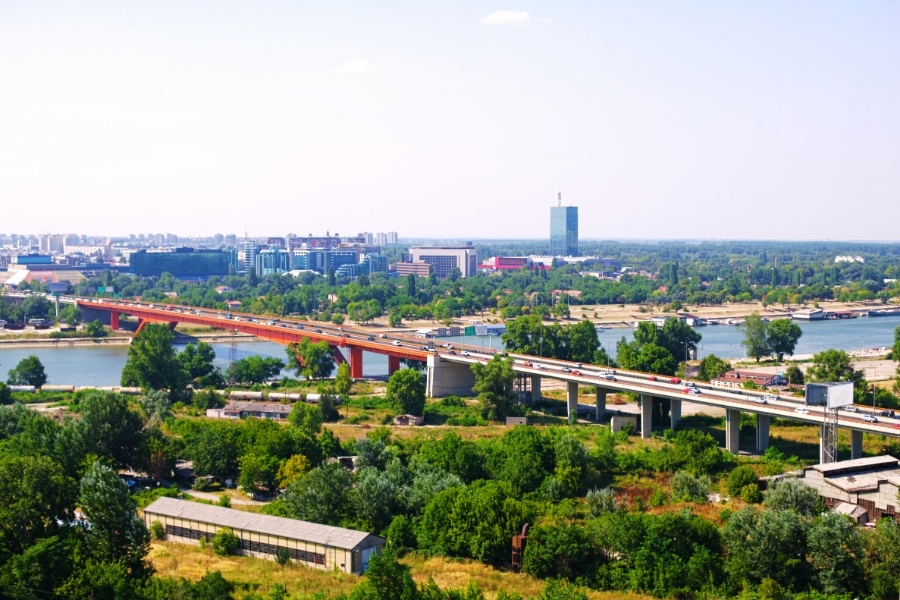
Gazela Bridge is the busiest bridge in Belgrade and central to the E75 motorway corridor. It carries the city’s main north-south highway across the Sava River and forms part of Belgrade’s urban motorway known as the City Highway. If you are driving through Serbia on the E75 from Hungary towards Niš and further south, or on the E70 from Croatia heading east, Gazela Bridge will be part of your route. It links New Belgrade with the older central areas near the main railway station.
The bridge was designed in the late 1960s and has three lanes in each direction. Although it was originally planned for far lower traffic volumes, it now handles well over 160,000 vehicles per day on average. This makes it one of the most heavily used pieces of road infrastructure in the country. As a result, traffic is often dense throughout the day, not only during traditional peak hours. The elevated position of the bridge offers wide views across New Belgrade and the historic city centre.
Gazela Bridge plays a vital role in keeping long-distance and local traffic moving through Belgrade. Crossing the Gazela at night can be striking, with city lights reflecting off the river and highlighting its elegant shape above the Sava.
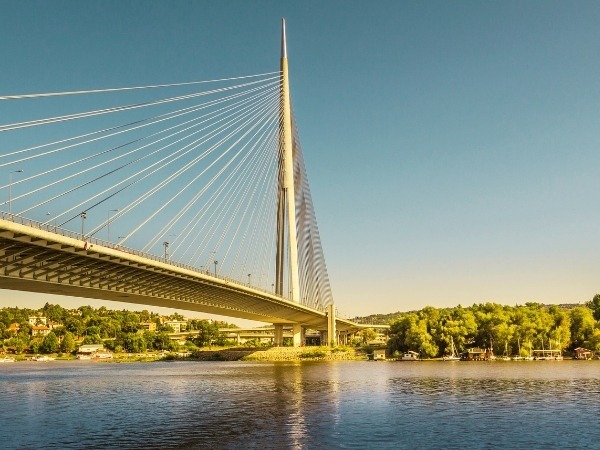
Ada Bridge is Belgrade’s newest road bridge over the Sava and one of the city’s most recognisable modern landmarks. Opened in January 2012, this cable-stayed bridge stands out for its clean lines and a single pylon that rises approximately 200 metres above the river. It connects the municipality of Čukarica on the south bank with New Belgrade on the north bank, passing over the edge of Ada Ciganlija. This popular river island is named after the bridge.
Built with six traffic lanes plus pedestrian and cycling paths, the bridge was designed to improve traffic flow and support Belgrade’s inner ring road system. Many locals and visitors regard Ada Bridge as one of the most beautiful bridges in Belgrade. Its elegant proportions and dramatic silhouette make it striking in the evening, when the cables and pylon are illuminated and reflected in the river below. Ada Bridge helps spread traffic more evenly across the Sava, particularly for journeys between southern or western Belgrade and New Belgrade.
Pančevo Bridge is Belgrade’s main crossing over the Danube, linking the city with its north-eastern outskirts and the town of Pančevo in Vojvodina. For decades, it was the only bridge across the Danube in the Belgrade area. If you are driving out of the city towards eastern Serbia or onward to Romania, this bridge is a key route. It carries both road and rail traffic, with vehicle lanes running alongside a single railway line.
From a driving perspective, Pančevo Bridge feels older and more utilitarian than newer crossings. It stretches for about 1 and a half kilometres across the Danube, with relatively narrow lanes and sections of uneven road surface. Traffic levels are generally moderate compared to those on central bridges, although busy periods can occur during commuter hours or industrial shift changes in Pančevo. Exposure to wind is also noticeable due to the open river setting, so drive steadily.
The crossing offers expansive views of the Danube and the surrounding landscape. You can see Great War Island and the distant outline of Belgrade’s skyline. Once on the eastern side, the road continues smoothly towards Pančevo and beyond, making this bridge a gateway to eastern Serbia.
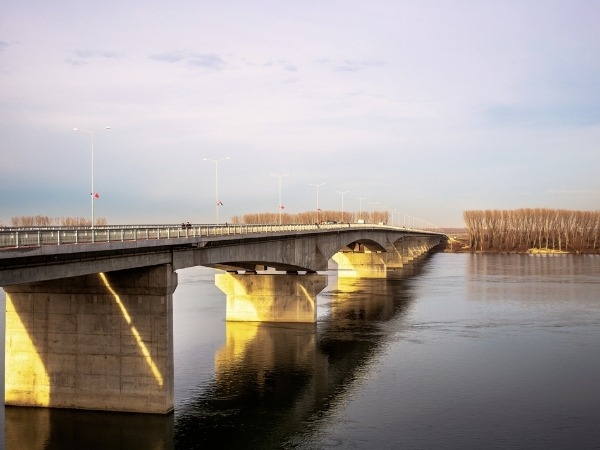
The Mihajlo Pupin Bridge opened in late 2014, strengthening the city’s northern connections. It spans the Danube in the far north of Belgrade, linking the Zemun area on the western bank with Borča on the eastern side. Locals sometimes refer to it by informal names, but officially, it honours Mihajlo Pupin, the renowned Serbian-American scientist.
For drivers passing through Serbia, this bridge is useful because it forms part of Belgrade’s outer bypass. It was the first new Danube crossing in the city in many decades and was designed to reduce pressure on inner-city bridges. Travellers coming from Hungary and heading towards Romania or southern Serbia can use this route to avoid central Belgrade entirely.
The bridge is long and built to modern standards, with two wide lanes in each direction and additional space for pedestrians and cyclists. It typically carries less local traffic than central crossings, so congestion is uncommon. The surrounding scenery is open and flat, with views over the Danube floodplains rather than dense urban areas.
On the eastern side, the bridge connects easily to roads leading towards Pančevo and the main ring routes, while the western end links with highways near Batajnica. If your navigation suggests this crossing to bypass the city centre, it is often the fastest option for travelling around Belgrade.
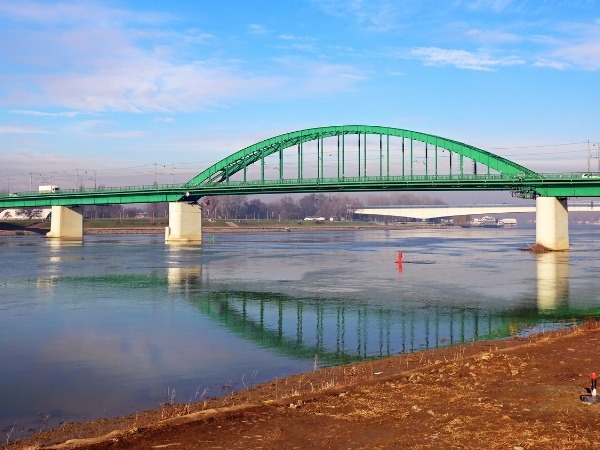
The Old Sava Bridge is a compact green steel bridge that has crossed the Sava River since the Second World War era. Smaller in scale than Belgrade’s other road bridges, it has only two traffic lanes, one in each direction, and also carries a tram line.
It directly connects the historic part of Belgrade, near the old bus station and waterfront, with New Belgrade, close to the Ušće park area. Due to its age and design, traffic moves slowly, with traffic lights controlling access at both ends and frequent queues forming when trams pass through.
This bridge is mainly used for local journeys rather than efficient cross-city travel. There are speed limits and weight restrictions, and the narrow roadway can be tight when cars and trams pass side by side. Many residents prefer faster crossings nearby when available, as this route leads quickly into city streets with multiple junctions and signals.
The Ostružnica Bridge forms part of Belgrade’s bypass, a ring road designed to allow traffic to pass around the city rather than through it. Located on the south-western edge of Belgrade, it crosses the Sava River at Ostružnica and links the motorway coming from the west with the route heading south. This connection allows long-distance traffic to move between major corridors without entering the urban area.
For through drivers and freight traffic, this bridge is one of the most practical crossings in the region. You can avoid central Belgrade and the busier inner city bridges. The crossing consists of two parallel structures that together provide six lanes of traffic. Its role is firmly focused on transit rather than local access.
The setting around the bridge is quieter and more open than the city centre. As you drive across, the surroundings are greener and more rural, with little sense of the city skyline. Despite this calm atmosphere, the bridge carries a steady flow of lorries, buses, and long-distance vehicles.
The Old Railway Bridge is another Belgrade crossing that is not used by road traffic. Originally dating back to 1884 and rebuilt after the Second World War, this iron lattice railway bridge spans the Sava and stands out for its traditional green metal structure. Historically, it carried the railway linking Belgrade with Zemun and onward into Central Europe.
Like several other historic bridges in Belgrade, it has endured periods of conflict and reconstruction. After the opening of the New Railway Bridge in 1979, the Old Railway Bridge lost its primary role as a main rail crossing and has been used minimally since then. It no longer offers regular train services and has no road access. The bridge is relevant only as a visual landmark. When crossing Branko’s Bridge or Gazela Bridge, you may spot it downstream, located lower over the water than the larger road bridges.
Driving in Belgrade is generally straightforward, but visitors can make avoidable mistakes when unfamiliar with the city’s traffic patterns. Most issues occur around major bridges, where timing, lane selection, and navigation are crucial.
Driving through Belgrade offers an opportunity to experience the city through its bridges. Each reveals a different perspective on the rivers, neighbourhoods, and skyline. Rent a car in Belgrade with Final Rentals to explore historic streets, riverside promenades, lively cafés, and panoramic viewpoints.
With Final Rentals, booking a car online is fast and simple. Select Belgrade Nikola Tesla Airport as your pickup location, enter your travel dates, and choose a vehicle for your trip. Book and manage your car rental at any time. Download the Final Rentals app on Google Play and the App Store.